
 Essential Oil
 Carrier or vegtetable oil
 Plant straight powder
 Ratio extracts
 Standardized plant extracts



| Commercial name | Plum |
| Botanical name | Prunus |
| Botanical family | Rosaceae |
| CAS # | 90082-87-4 |
| Plant part | Seed |
| Origin | China |
Plum Kernel Oil
L’huile de prune est un ingrédient soluble dans l’huile qui peut être utilisé dans tout produit anhydre ou dans la phase huileuse d’un produit émulsionné. Il a un merveilleux arôme naturel avec des notes d’amandes et de fruits, qui peuvent apparaître dans le produit final en fonction du niveau de concentration. C’est un produit biodégradable et sans OGM.
IDENTFICATION DATA
Related products


Brazil Nut Oil
The Brazil nut is, in fact, a seed rather than a nut, but popular usage continues to prevail. Nutritionally, Brazil nuts are an excellent source of selenium and a good source of magnesium and thiamine. There are 14% protein, 11% carbohydrates, and 67% fat (1). The fat breakdown is roughly 25% saturated, 41% monounsaturated, and 34% polyunsaturated. The absolute saturated fat content of Brazil nuts is among the highest of all nuts, surpassing even macadamia nuts.
The proteins found in Brazil nuts are very high in sulfur-containing amino acids like cysteine (8%) and methionine (18%) and are also extremely rich in glutamine, glutamic acid, and arginine. The presence of these amino acids enhances the absorption of selenium and other minerals in the nut.
As with most nuts, the Brazil nut is rich in oils, variously reported at 65-70% of seed dry weight. Brazil nut oil is clear yellowish oil, which has a pleasant and sweet smell and taste.
Its texture and aroma gives it great versatility for use in a wide array of innovative personal care products. Brazil Nut Oil's high selenium content offers strong antioxidant properties. When used in personal care products, Brazil Oil hydrates and softens the skin.
Today, Brazil nut oil is used in soaps, shampoos and hair conditioning/repair products. As a hair conditioner it brings shine, silkiness, malleability and softness to hair. It helps renew dry, lifeless hair and split-ends and allows hair to remain soft and silky. It provides stabilising detergent properties and helps clean the hair.


Green coffee bean oil
Coffee plants are native to the tropical regions of South America, Asia and Africa. The plant is a small shrub that typically reaches 3-4 meters in height. The seeds of the coffee plant are commonly referred to as beans. Roasting coffee beans changes the chemical and aromatic composition of the beans.
Green Coffee Oil is rich in phytosterols that promote excellent moisture retention, quick penetration and good adherence within cosmetic applications. It is also exceptionally high in its composition of essential fatty acids.


Perilla Oil
Perilla is usually consumed directly in everyday life. The leaves are green (purple coloured if still young age) is used as a complement in salads, this leaves well-known in the culture barbeque in Korea. The seeds can be extracted an oil which is rich in benefits.
Perilla seed oil contains high levels of omega 3 fatty acids that are known to have antiseptic activity and to be effective against the bacteria responsible for acne. capacity is also attributed to this oil to suppress chronic inflammation and itching. Perilla seed oil is particularly suitable for use in a mixture, in facial massage oil, lotion, cream and as part of the scrub salt formulations.


Chia seed oil
Chia seed oil is cold-pressed extracted from the chia seeds commonly referred to as a superfood.
Chia seed oil is an especially great option for vegetarians and vegans to obtain omega-3 fatty acids from a botanical source. It is a popular supplement due to its high level of alpha-Linolenic acid (ALA) which cannot be produced by the body, but must be obtained through the diet alone. Chia seed oil is also used in the food industry as a cooking oil and as a popular ingredient in various salad dressings. In the cosmetic industry chia seed oil is used in body creams and lotions used topically to treat dry skin and promote healthier hair.
The seeds yield 25–30% extractable oil


Tamanu Oil
The tamanu tree is indigenous to tropical Southeast Asia; it is found in Thailand, Vietnam, Myanmar, Malaysia, South India, Sri Lanka, and the Melanesian and Polynesian islands. It grows up to three meters tall, sporting cracked, black bark and elliptical, shiny leaves. The tamanu tree blooms twice annually with fragrant, white flowers, which later yield clusters of yellow-skinned spherical fruit. The fruit's pulp tastes similar to an apple, within which a large nut is embedded. The nut contains an odorless pale kernel. This kernel is dried in the sun until it becomes sticky with a dark, thick, rich oil; it must be protected from humidity and rain during drying.
This sticky oil is cold-pressed to make a greenish oil. Polynesian Natives believed the tamanu tree was a sacred gift of nature. It was an answer to skin protection from hot sun, high humidity and ocean wind.
It is reputed to have wondrous wound-healing properties, as well as being a cure-all for almost every skin ailment you can think of, from acne to eczema to psoriasis, but all of the miraculous claims are hinged on anecdotal, not scientific, evidence. There’s no harm in using this oil in skin care.
Based on those traditional uses, tamanu oil has been thoroughly researched, and the conclusive evidence on its ability to heal damaged skin is overwhelming. Its benefits are notable for scarring, stretch marks, minor cuts and abrasions, rashes, sores, and much more. It can be used directly on the skin or mixed within formulations. Stores well under any condition but extreme heat will lessen the shelf life.
Tamanu oil has a rich, deep scent with a bold dark colour and because of this it may alter the colour and aroma of cosmetic creations. Tamanu oil may naturally separate or solidify at cold temperatures.


Pumpkin Seed Oil
The pumpkin grows as a large, annual creeper. The stems, thick and non-lignified, elongate rapidly in one season, sometimes over 5 m, with some branching. The leaves are alternate, carried by a long upright petiole. They deploy a large palmate blade, almost rounded, presenting 3 important veins. The rod crawls or sometimes climbs on a support. The plant is covered with fine transparent hairs, unpleasant to the touch.
The flowers appear in summer, male flowers first, then female flower next, recognizable by its inferior ovary, a small ball under the flower. The stems should be long and branched to produce several female flowers.
The fruits are massive and rounded, capable of weighing more than 15 kg. The pumpkin is yellow as it grows, then turns orange as it ripens. It contains large, flat seeds, rich in nutrients

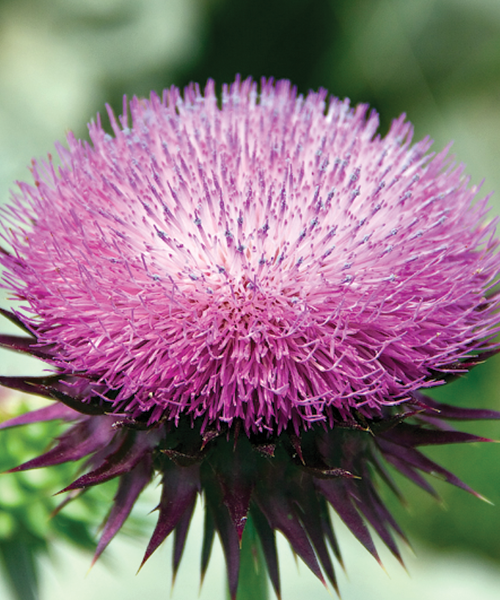
Milk Thistle Oil
The silymarin is substance in the seeds. It protects the liver against the action usually very harmful for certain products. Clinical trials have demonstrated that one could prevent severe liver poisoning due to the ingestion of carbon tetrachloride or poisonous mushrooms, taking the sylimarme just before or within 48 hours. In Germany, silymarin is used successfully to treat hepatitis and liver cirrhosis.

Silybine chemical structure